Highlights:
- Achieved greater than 99.9% reduction in PFAS concentrations within the treatment barrier, with concentrations in many monitoring wells declining to below 4 ng/L and some reaching as low as 1 ng/L.
- Successfully treated a heavily contaminated groundwater plume, reducing PFAS concentrations from levels exceeding 100,000 ng/L by up to five orders of magnitude.
- Demonstrated significant downgradient benefits, with monitoring wells located within the barrier’s treatment zone showing PFAS concentration reductions greater than 99% as treated groundwater migrated through the aquifer.
- Provided evidence of precursor PFAS immobilization, including both target and non-target precursor compounds that can contribute to long-term PFAS loading and complicate remediation efforts.
- Estimated immobilization of approximately one kilogram of PFAS mass per year, significantly reducing PFAS loading to downgradient receptors and surrounding surface waters.
- Validated CAC barriers as a practical in situ alternative to long-term pump-and-treat systems, offering an effective approach for controlling PFAS migration while avoiding above-ground treatment infrastructure and waste generation.
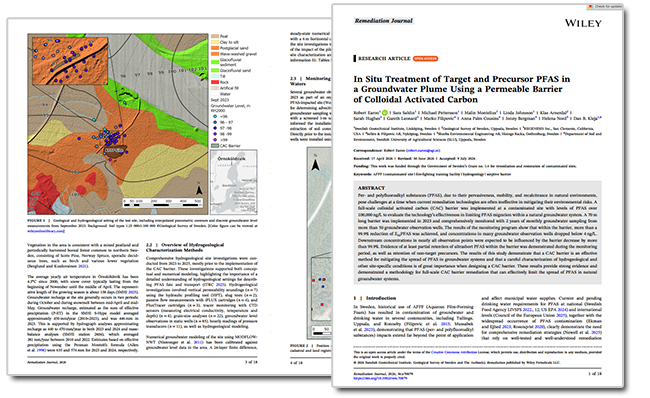
This full-scale field study evaluated the performance of a permeable colloidal activated carbon (CAC) barrier installed at a PFAS-contaminated firefighting training site in Sweden. The 70-meter-long barrier was designed to intercept a high-strength groundwater plume containing PFAS concentrations exceeding 100,000 ng/L. Supported by more than two years of monthly monitoring from over 50 groundwater wells, the study demonstrated that CAC barriers can effectively immobilize a broad range of PFAS compounds, including target PFAS, precursor compounds, and even some ultrashort-chain PFAS, achieving reductions greater than 99.9% while significantly limiting contaminant migration downgradient.