Learn the following in this Technical Bulletin:
- How an S-MicroZVI-only barrier was designed and installed to intercept cVOC mass flux within a high-velocity groundwater plume.
- How monitoring approximately 30 feet downgradient documented 98.5% to 99.4% reductions in PCE, TCE, cis-1,2-DCE, and VC from their respective post-application peak concentrations.
- How substantial cVOC reductions were also documented approximately 190 feet downgradient, providing a longer-distance record of plume improvement.
- Why concentration trends, transformation products, geochemistry, and hydraulic relationships should be evaluated together when assessing long-term treatment performance.
- How sustained concentration reductions remained evident 5.5 years after application, extending beyond the original projected 3- to 5-year treatment longevity.
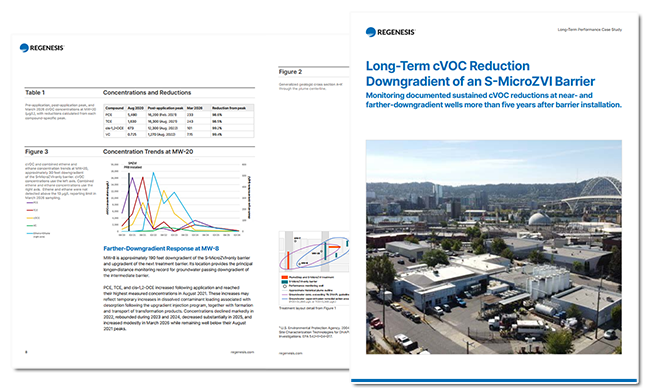
See how a strategically placed S-MicroZVI barrier contributed to sustained reductions in chlorinated volatile organic compounds (cVOCs) at a former industrial facility with a plume extending more than 2,000 feet. This technical bulletin examines more than five years of monitoring data, documenting substantial reductions in PCE, TCE, cis-1,2-DCE, and vinyl chloride at downgradient monitoring wells, including performance beyond the original 3- to 5-year treatment design period.