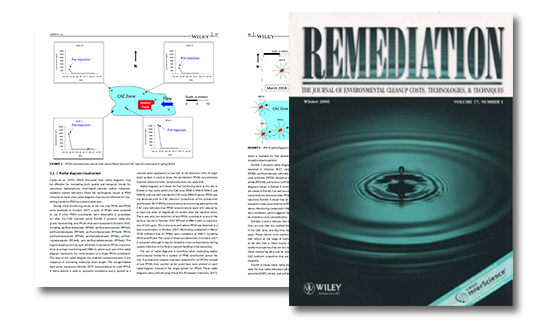
This article published in Wiley’s Remediation Journal uses various visualization and modeling methods to evaluate the in situ remediation of PFAS via colloidal activated carbon (CAC) at a site in Central Canada. A three-dimensional reactive transport model (ISR-MT3DMS) was used to indicate that the CAC remedy implemented at the site is likely to be effective for PFOS remediation for decades.
Remedial evaluation highlights featured in this article:
- The in situ CAC remedy for PFOS at this site is likely to be effective for decades.
- The only alternative to using in situ CAC injections at this site would be Pump and Treat (P&T), which would have to be operated for decades due to the ongoing nature of the PFAS source.
- It is also possible to combine P&T and CAC in a site management strategy, such as using P&T at a site boundary where PFAS concentrations are higher, and implementing CAC barriers downgradient to mitigate plume migration.
- Due to the relatively low cost to implement the CAC, and the ability to adapt the remedy in the future, this remediation approach may be viable at other PFAS sites.