PFAS Monitored Attenuation
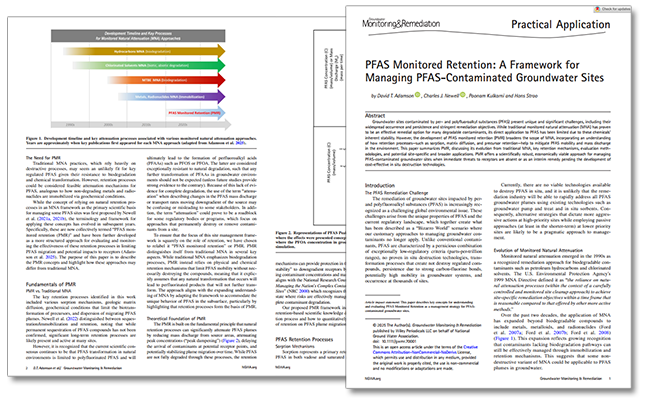
The article “PFAS Monitored Retention: A Framework for Managing PFAS-Contaminated Groundwater Sites” by Charles Newell et al. outlines PFAS Monitored Retention (PMR) as an evolution of traditional monitored natural attenuation (MNA), providing a scientifically robust and economically viable method for managing PFAS-impacted groundwater. PMR leverages natural retention processes—such as sorption, matrix diffusion, and precursor retention—to slow PFAS migration and reduce risks to receptors, particularly at sites without immediate exposure threats. Backed by field studies, modeling, and analytical data, PMR demonstrates how understanding and enhancing these retention mechanisms can serve as a practical management strategy. In-situ treatment solutions, such as the application of colloidal activated carbon, can build upon this PMR framework to permanently immobilize PFAS, effectively eliminating risk while reducing remediation costs to roughly one-third of traditional pump-and-treat systems—delivering both proven performance and independent scientific validation.
Key Takeaways and Other Considerations:
- Scientific validation of PFAS retention – PMR builds on peer-reviewed research showing that natural retention processes significantly limit PFAS migration, providing a solid foundation for in-situ treatments like colloidal activated carbon.
- Risk elimination at a fraction of the cost – In-situ colloidal activated carbon treatment enhances PMR by permanently immobilizing PFAS in place, achieving regulatory goals at about one-third the cost of pump-and-treat systems.
- Backed by third-party research – Field studies and modeling cited in the PMR framework align with independent scientific evidence supporting the long-term stability and effectiveness of colloidal activated carbon for PFAS remediation.