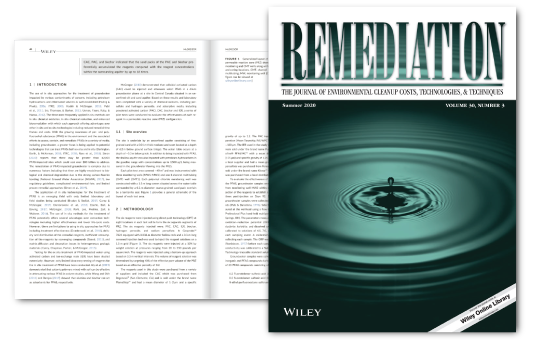
This article published in Wiley’s Remediation Journal reviews six pilot-scale in-situ field studies of an unconfined sand aquifer impacted by both petroleum hydrocarbons and PFAS to determine if a variety of reagents could be used to attenuate the dissolved PFAS. The reagents were injected using direct push technology, and consisted of two chemical oxidants and four adsorbents. Performance results gathered downgradient of six permeable reactive zones 18-months post application are provided.
Highlights of the results documented in this research article:
- The only reagent out of the six that reduced PFAS to below detection limits *and* prevented contaminant breakthrough was PlumeStop colloidal activated carbon
- While contaminant concentrations in zones treated by all the adsorbents were determined to be less than detection limits, all but one – colloidal activated carbon – exhibited partial or complete breakthrough
- Results indicated that the PFAS contaminants were not treated by the oxidants