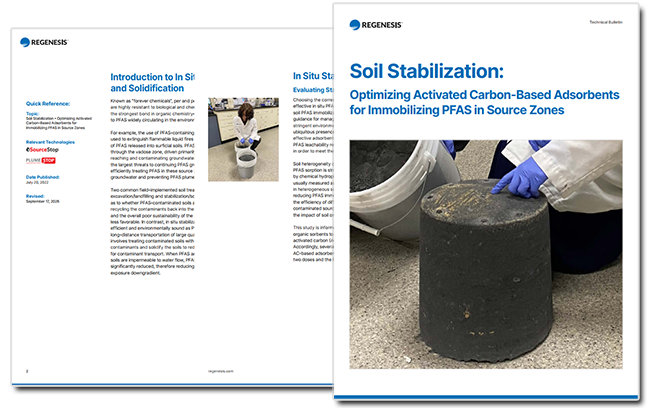
- Learn how in situ soil stabilization reduces PFAS migration. Discover how immobilizing PFAS in source zone soils can minimize contaminant transport to groundwater and surface water.
- Review performance data from AFFF-impacted sites. See results from laboratory testing conducted on soils from two PFAS-impacted locations with different PFAS profiles and organic carbon content.
- Understand the impact of adsorbent selection and dosing. Compare the effectiveness of multiple activated carbon-based amendments applied at 1% and 5% treatment doses.
- See how PFAS leachability was reduced by more than 95%. Testing demonstrated significant reductions in PFAS mobility, with 5% treatment doses achieving greater than 99% leachability reduction across multiple adsorbents.
- Explore integrated source treatment strategies. Learn how soil stabilization can be combined with technologies such as SourceStop and PlumeStop to address PFAS across the vadose zone, capillary fringe, and groundwater.
PFAS-contaminated soils can act as long-term sources of groundwater contamination, making effective source zone treatment essential for protecting downgradient receptors. This technical bulletin explores how activated carbon-based adsorbents can be used to immobilize PFAS in impacted soils through in situ stabilization, reducing PFAS mobility and leachability by up to 99% while providing a more sustainable alternative to excavation and disposal.