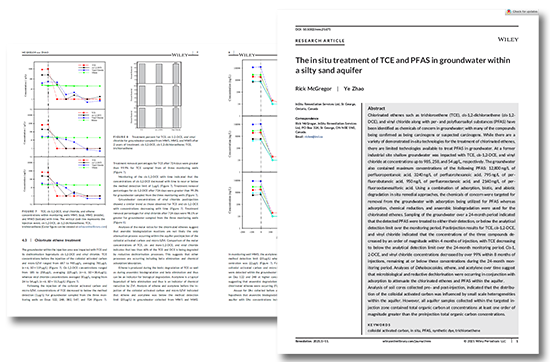
This article published in Wiley’s Remediation Journal reviews a case study of in-situ treatment of TCE and PFAS in groundwater at an industrial site within a silty sand aquifer. Using a combination of adsorption, biotic, and abiotic degradation in-situ remedial approaches, the chemicals of concern were targeted for removal from the groundwater with adsorption being utilized for PFAS whereas adsorption, chemical reduction, and anaerobic biodegradation were used for the chlorinated ethenes.
Highlights of the results documented in this research article:
- Sampling of the groundwater over a 24‐month period indicated that the detected PFAS were treated to either their detection, or below the analytical detection limit over the monitoring period
- Post injection results for TCE, cis‐1,2‐DCE, and vinyl chloride indicated that the concentrations of the three compounds decreased by an order of magnitude within 4 months of injection, with TCE decreasing to below the analytical detection limit over the 24‐month monitoring period
- Analyses of Dehalococcoides sp., ethene, and acetylene over time suggest that microbiological and reductive dechlorination were occurring in conjunction with adsorption to attenuate the chlorinated ethenes and PFAS within the aquifer